The sun sets over a kingdom divided, where the shadows of two lions—black and white—stretch across the land in a looming struggle for power. You are Ramza Beoulve, third son of a noble house, raised alongside Delita, a commoner who shares your bond but not your station. In a world where birth dictates destiny, you are about to learn that nothing in Ivalice is as it seems.
Welcome to Final Fantasy Tactics: The Ivalice Chronicles, where political intrigue and tactical warfare collide in what many consider the pinnacle of the strategy RPG genre. This isn’t merely a game of moving units across a grid; it’s a deep, emotionally charged journey through a war-torn land where allegiances shift like desert sands and today’s ally may become tomorrow’s enemy. As a returning veteran who has spent countless hours navigating Ivalice’s battlefields, I remember my first foray—the initial confusion over complex systems, the devastating loss of units to permanent death, the triumphant moment when strategy finally clicked into place.
This FINAL FANTASY TACTICS Beginner’s guide will help you avoid those early pitfalls while immersing you in one of gaming’s most richly woven narratives. We’ll walk through essential mechanics not as dry textbook lessons, but as hard-won wisdom from the front lines, preparing you to lead your forces with confidence through the coming storm.
Your First Steps in Ivalice
Choosing Your Path as a Beginner
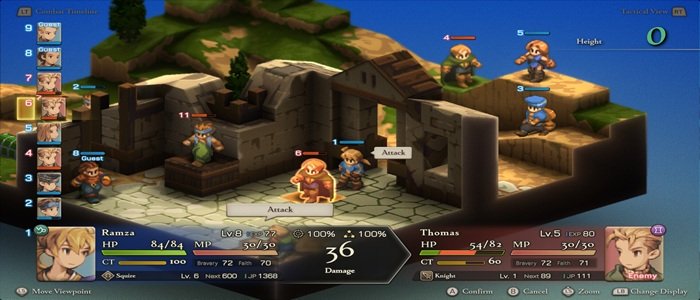
Before you even set foot on the battlefield, The Ivalice Chronicles presents you with crucial decisions that will shape your entire journey. The enhanced edition offers multiple difficulty settings designed to accommodate different playstyles :
- Squire Mode: Perfect for players primarily interested in experiencing the emotionally charged story without excessive frustration. Enemies are more forgiving, allowing you to enjoy the narrative without hitting significant roadblocks.
- Knight Mode: The standard balanced experience that provides a satisfying tactical challenge while still being accessible. Recommended for most first-time players who want to engage with the game’s strategic depth.
- Tactician Mode: For veterans seeking a true test of skill, where every positioning decision matters and enemies hit considerably harder. Not recommended for beginners.
Your choice here is more than mere preference—it’s about how you want to experience the War of the Lions. I started on Knight mode myself, finding that perfect balance between tactical engagement and narrative flow that made each story beat feel earned through thoughtful combat.
Battle in FINAL FANTASY TACTICS
Two stats will become your constant companions throughout the campaign, and grasping their significance early will save you countless headaches:
- Bravery (BR): Ranging from 1-100, this measures a unit’s courage in battle. Higher Bravery not only increases physical attack power but also dramatically improves the activation rate of lifesaving reaction abilities like Auto-Potion . Frontline fighters should ideally have Bravery of 70 or higher.
- Faith (FA): Similarly scaled, Faith determines magical potency—both for spells cast and received. A high-Faith character will devastate enemies with magic but will also be more vulnerable to enemy spells. This creates fascinating strategic trade-offs for your spellcasters.
These aren’t just numbers on a screen; they’re reflections of your units’ spirits. I’ll never forget watching my low-Faith knight shrug off enemy spells that would have incinerated others, while my high-Faith wizard delivered the finishing blow with a perfectly timed Thundara.
Team
The clang of steel echoes through Mandalia Plains as you face your first real test against the Corpse Brigade. This is where you’ll learn that individual skill matters less than cohesive strategy.
Your initial roster may seem overwhelming, but a balanced starting team will carry you through the early battles:
- Visit the Warriors’ Guild early to recruit additional units, paying close attention to their innate Bravery and Faith. Look for at least one character with 70+ Faith for magic roles and another with 70+ Bravery for frontline duty.
- Diversify your Zodiac signs rather than clustering around one type. This ensures your healer won’t have compatibility issues with half your party.
- Don’t grow too attached to your initial generic units. While they’re valuable for learning the game, unique story characters who join later will often surpass them in capability.
The Job System
The Economy of Job Points
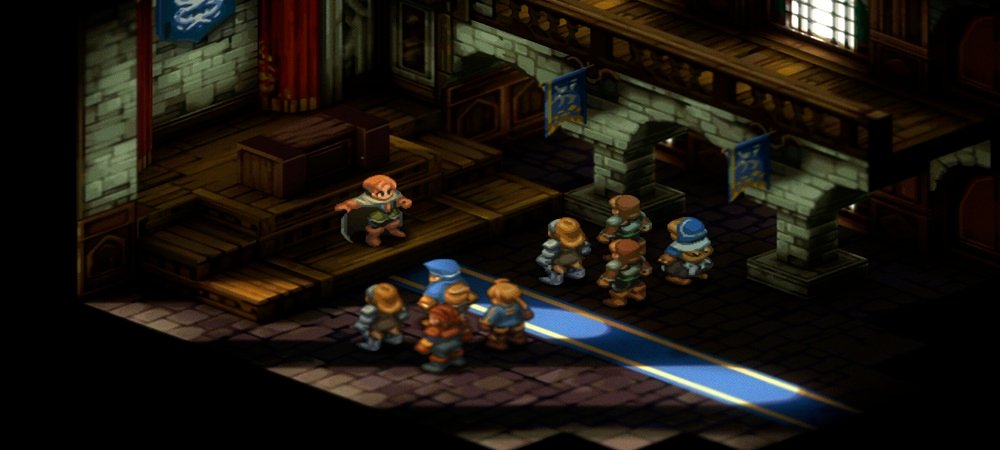
The Job System in Final Fantasy Tactics represents one of the most flexible class systems in RPG history, but its depth can overwhelm newcomers. Understanding Job Points (JP) is crucial to progression:
- Every action in battle earns JP for that unit’s current job, in addition to standard experience points.
- JP spillover is perhaps the most valuable hidden mechanic—when any unit earns JP in a particular job, all other deployed units receive 20% of those points toward the same job, even if they haven’t unlocked it yet. This means fielding multiple units in the same job can rapidly accelerate your progression across your entire roster.
- JP Up, a Squire support ability, doubles JP gains from every action. This should be every unit’s first significant investment, as the accelerated progression pays dividends throughout the entire game.
I made the mistake of ignoring JP Up on my first playthrough, not realizing how much faster I could have unlocked those game-changing advanced jobs. Don’t repeat my error—those early points invested in Squire will repay you a hundredfold.
Essential Early Job Abilities
Smart Job Progression
The clatter of armor echoes through the training grounds as your squire practices his forms. In a few weeks’ time, that same soldier might be calling down meteors as a Wizard or delivering crushing blows as a Monk. Growth in Ivalice is not linear—it branches like the ancient trees of the Weald.
While you can certainly experiment, having a roadmap will prevent wasted effort:
- Start every unit as a Squire until they learn JP Up—this single decision will accelerate your entire progression.
- Unlock Chemist basics on multiple units—at a minimum, ensure several party members have access to Potion and Phoenix Down for emergency healing and revival.
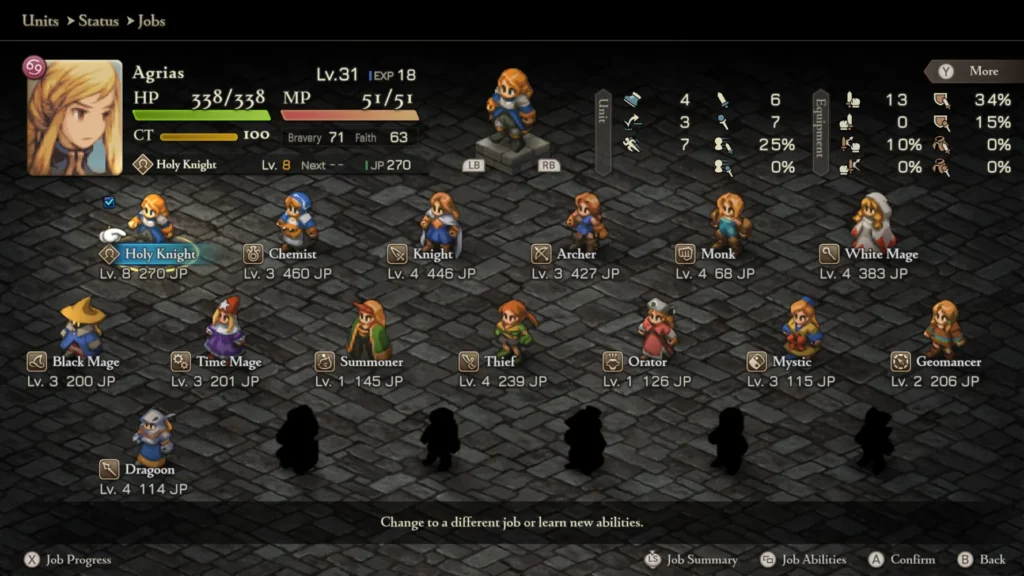
- Plan your advanced jobs early—the game now features an official Job Tree showing requirements. For instance, unlocking the powerful Monk requires Level 2 Squire and Level 2 Knight.
- Ramza makes an exceptional Monk—his innate stats synergize beautifully with the job, and the Martial Arts skills provide incredible versatility with ranged attacks, healing, and revival at no MP cost.
Battlefield Strategy
The Terrain of War
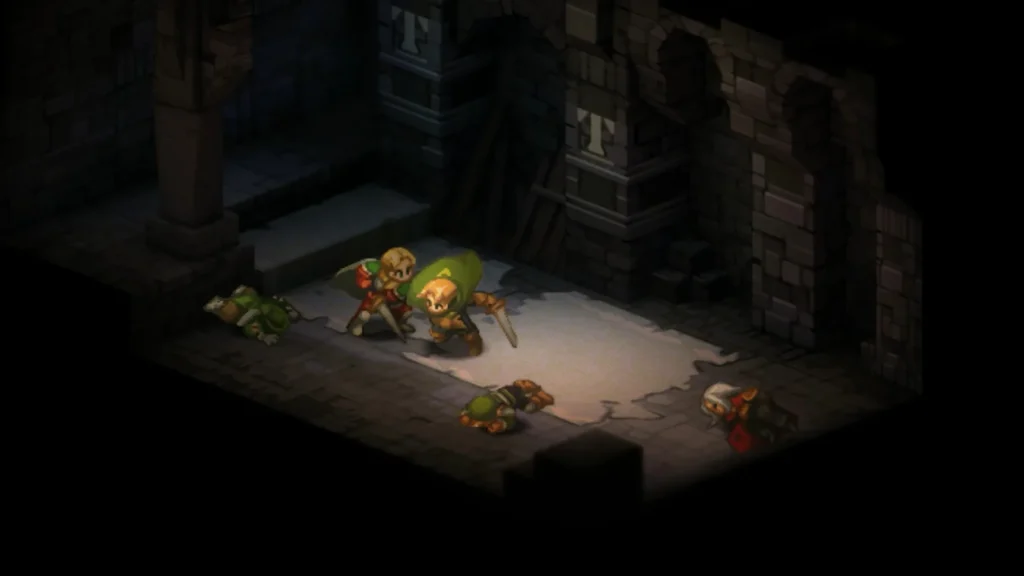
The high ground of Dorter’s slums provides a devastating advantage to enemy archers, their arrows raining down on your trapped units below. You realize too late that positioning can decide battles before a single sword is swung.
The 3D battlefields of Ivalice aren’t just backdrops—they’re active elements of your strategy:
- Height advantages are crucial for ranged units. Archers and mages on elevated positions gain extended range and better accuracy.
- Facing direction matters immensely. Attacks from the side deal more damage, while attacks from behind never miss. Always end your turns with units facing toward enemies.
- Use obstacles as natural chokepoints to funnel enemies into kill zones where your area-effect spells can shine.
- Movement abilities are more valuable than they appear. The humble Move+1 from the Squire tree can mean the difference between reaching a critical enemy and wasting a turn.
The Rhythm of Combat
In a game where a single misstep can cost a unit permanently, understanding combat flow is essential:
- Don’t rush forward aggressively. The game teaches this lesson early when Delita warns Ramza to proceed carefully. Spreading your forces too thin leaves them isolated and vulnerable to being picked off.
- Always have at least one character with Item command equipped. When a unit falls, you have only three turns to revive them before they’re gone forever. Phoenix Down access is non-negotiable.
- Focus fire on one enemy at a time. Wounding multiple enemies is less valuable than completely removing threats from the battlefield.
- Remember that defeating the boss ends most battles immediately. When overwhelmed by reinforcements, sometimes the smartest strategy is a calculated strike at the enemy commander.
Tactical Concepts
Progression Systems
As you move beyond the basics, several systems will ensure your party continues to grow in power and versatility:
- Errands become available in Chapter 2, allowing you to send benched party members on missions that reward JP, gil, and items without gaining EXP. This is perfect for learning new jobs without overleveling your main party .
- Stat growth ties to your current job during level up. Knights and Monks gain more HP per level, while Ninjas and Thieves develop higher Speed. For optimized characters, consider their job during level-ups .
- Unique characters like Agrias and Mustadio join throughout the story and bring powerful exclusive classes. While your generics can be effective, these special units often outperform them significantly .
Economy and Equipment Tips
The war in Ivalice isn’t just fought with swords and spells—it’s funded by gil:
- Regularly check outfitters for new gear, as their inventory updates after story battles. Armor doesn’t increase defense directly but raises HP and MP pools .
- Sell outdated equipment rather than hoarding it—gil constraints are very real in the early game .
- Use the ‘Optimize Equipment’ function when unsure—it generally does a respectable job equipping your party effectively .
- Farm gil strategically when needed by repeating random battles in areas with human enemies who drop valuable equipment .
Final Thoughts
The path before you is long, Commander. You will witness betrayals that shake your faith in chivalry, form bonds that transcend social station, and uncover conspiracies that threaten the very fabric of Ivalice. Through it all, remember that every setback is a lesson in disguise.