Welcome to the brutal yet rewarding world of Nioh 3, Team Ninja’s latest evolution in the “masocore” genre. Set against the historically turbulent Bakumatsu period, this installment marks a significant shift for the series by introducing an open-field exploration format. While the game’s atmosphere remains as dark and punishing as its predecessors, the expanded world offers more freedom to explore, allowing you to discover secrets, tackle optional objectives, and even overlevel your character to make the legendary boss encounters more manageable.
The core of your journey lies in mastering the brand-new Style-Switching system, which allows you to pivot instantly between Samurai Style and Ninja Style. Samurai Style retains the series’ classic three-stance system (Low, Medium, High) and the rhythmic Ki Pulse to manage stamina. This Beginner’s Guide is designed to help you navigate these complex systems, from choosing your starting weapons—like the versatile Katana or Spear—to mastering the Burst Break counter. Whether you are a series veteran or a newcomer stepping into the Sengoku mythos for the first time, preparing for the challenges ahead is essential.
Samurai and Ninja Stances

In Nioh 3, the series signature combat complexity is expanded through the Style Shift system, which allows you to switch instantly between Samurai Style and Ninja Style using the R2 button. Each style offers a completely different tactical approach to managing stamina and countering enemies.
Samurai Style: Traditional Stances
Samurai Style focuses on direct, head-on combat and relies on the classic three-stance system. Mastering these is essential for managing Ki (stamina) via the Ki Pulse mechanic.
| Stance | Primary Focus | Best Used For |
|---|---|---|
| High Stance | Maximum Damage | Punishing slow enemies or breaking their guard; has high Ki costs. |
| Mid Stance | Defense & Balance | The default starting stance; best for blocking and facing groups. |
| Low Stance | Evasion & Speed | Rapid movement and dodging with minimal Ki consumption. |
- How to Switch Stances: While in Samurai Style, hold Square (PS) or X (Xbox) and press the corresponding button: Triangle/Y for High, Square/X for Mid, or X/A for Low.
- Unlocking Stances: Only Mid Stance is available by default; you must unlock High and Low stances in the Samurai skill tree using skill points.
Ninja Style: Agility and Stealth
Ninja Style is a new, faster alternative that trades defensive blocking for high mobility and specialized tools.
- The Mist System: Unlike Samurai, Ninja Style does not use Ki Pulse. Instead, pressing R1 after an attack activates Mist, a rapid evasion maneuver that reposition’s you behind the enemy.
- Backstab Damage: This style deals significantly more damage when striking from behind compared to the Samurai style.
- Aerial Finesse: It features specialized aerial actions and hit-and-run tactics using various Ninjutsu tools.
Tactical Switching
A key advanced tactic is the Style Switch Loop. You can start in Ninja Style to quickly deplete an enemy’s Ki with fast strikes, then shift to Samurai High Stance to deliver a high-damage finishing blow once they are winded.
Best Beginner Weapons
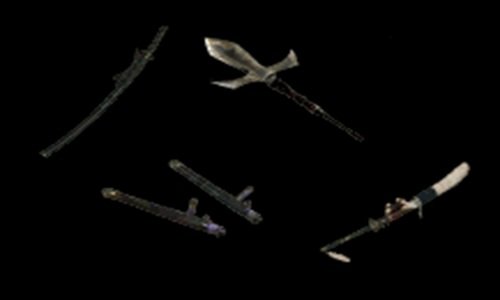
Choosing the right weapon in Nioh 3 is more than just a matter of damage; it is about how you want to interact with the game’s new Style-Switching system. Because you can swap instantly between Samurai Style (which uses the traditional three stances and Ki Pulse) and Ninja Style (which focuses on mobility and tools), your choice of weapon for each style should complement the other. Beginners should aim for weapons that provide a safety net—either through superior range or ease of use—to help manage the steep learning curve of the Bakumatsu period.
The following table breaks down the most approachable weapons for new players, categorized by their respective combat styles:
| Weapon Type | Combat Style | Key Strength | Why it’s Beginner Friendly |
|---|---|---|---|
| Spear | Samurai | Reach & Range | Its long range allows you to strike enemies before they can get close enough to retaliate. The “Spear Flourish” skill also helps stagger enemies during a Ki Pulse. |
| Sword (Katana) | Samurai | Versatility | The quintessential “jack-of-all-trades” weapon. It has a balanced moveset across all three stances and is the best tool for learning the game’s core mechanics like parrying and Ki management. |
| Tonfa | Ninja | Ki Damage & Speed | Excellent at draining an enemy’s stamina (Ki) quickly. It also allows for unique defensive moves like the “Impenetrability” skill, which is rare for fast-paced Ninja weapons. |
| Ninja Sword | Ninja | Balance & Evasion | Very similar to the standard Katana but optimized for the Ninja style’s high mobility. It offers straightforward combos and reliable escapes, making it the safest entry point for the Ninja style. |
| Odachi | Samurai | High Stance Power | Combines the reach of a Spear with the damage of an Axe. Its wide, sweeping arcs make it highly effective for managing groups of enemies in Mid Stance or dealing massive “Burst” damage in High Stance. |
Starter Tips for Weapon Choice
- Synergize Your Stats: Every weapon scales with three specific stats. For a cohesive build, try to pick a Samurai and Ninja weapon that share at least one primary stat (e.g., Constitution for Spear and Tonfa) so both remain powerful as you level up.
- Unlock Your Stances: In Nioh 3, Samurai weapons only start with one stance. Prioritize unlocking Low Stance (for dodging) and High Stance (for damage) in the Samurai skill tree as soon as possible.
- Master the Burst Break: Regardless of your weapon, practice the Burst Break counter early on. Every weapon can perform this to interrupt the devastating “red aura” attacks from bosses, which is essential for survival.
Best Starting Attributes
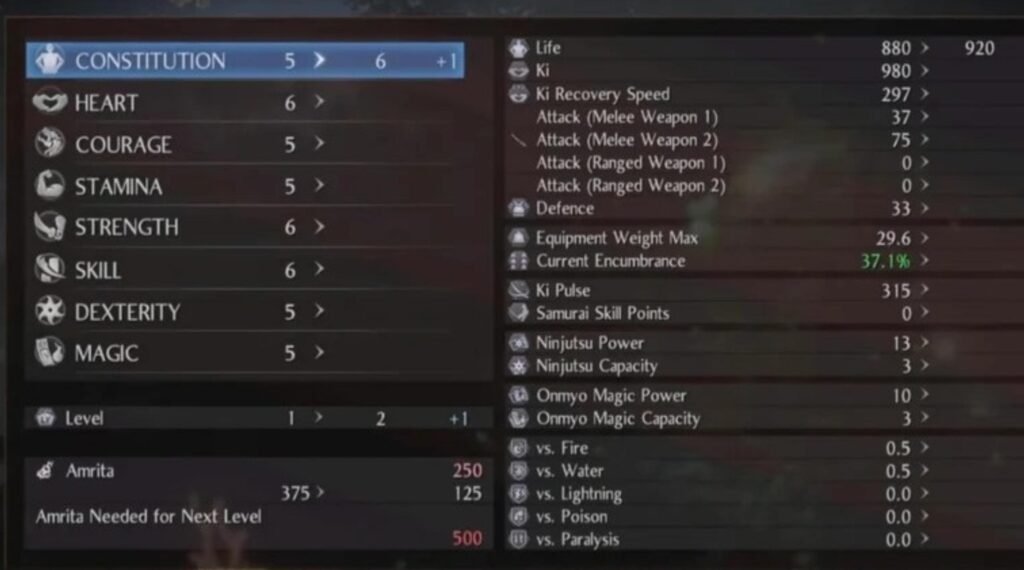
In Nioh 3, stat distribution has been streamlined compared to previous entries. There are 7 core attributes, and the traditional “letter scaling” (A, B, C) has been replaced with equal scaling across three primary stats for every weapon. This means if a weapon scales with Heart, Strength, and Intellect, raising any of those to 50 will yield the exact same damage increase.
For a beginner, the most effective strategy is to reach 10 points in every attribute first to meet the minimum requirements for early-game gear and Guardian Spirits. After that, you should focus on the stats that synergize with your chosen Samurai and Ninja weapon pair.
Recommended Early Game Allocation
- Baseline (Levels 1-15): Aim for 10 in all attributes. This ensures you can equip almost any loot drop and provides a balanced pool of Health and Ki.
- Agility Focus: Raise Stamina just enough to keep your Equipment Weight under 70% (B-tier Agility). Going over this makes your ki management much harder.
- Weapon Synergy: Identify the overlapping stat between your two weapons. For example, if using a Spear and Tonfas, prioritize Constitution and Skill to maximize the damage for both simultaneously.
- Respeccing: Do not fear “wrong” choices; you can obtain stat respec books (Book of Reincarnation) starting in the 3rd region of the game to completely redistribute your points.
Essential Early-Game Skills
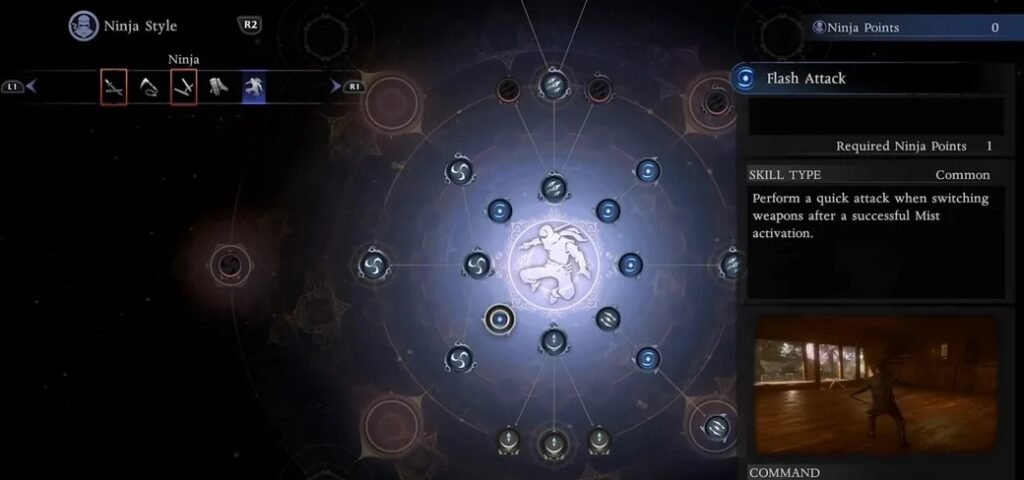
the skill system is divided into three distinct categories: Samurai, Ninja, and Common. Unlike previous games, most of these are passive buffs or mechanical enablers that you must “slot” into your limited Skill Capacity. To unlock them, you’ll need to find Secret Skill Texts hidden in chests, dropped by bosses, or rewarded for clearing Crucible Spikes across the open world.
For a beginner, the priority is to unlock skills that improve Ki (stamina) management and enhance the game’s unique Style-Switching counters.
| Skill Name | Category | Type | Effect |
|---|---|---|---|
| Deflect | Samurai | Martial Art | A perfect guard (tap L1/LB) that negates damage and restores Ki. |
| Evade | Ninja | Ninjutsu | A perfect dodge that restores Ki and grants brief invulnerability. |
| Flux (I & II) | Samurai | Passive | Regain massive amounts of Ki by switching stances during a Ki Pulse. |
| Running Water | Samurai | Passive | Allows you to perform a Ki Pulse automatically by dodging. |
| Repel Expert | Common | Passive | Extends the timing window for a successful Burst Break counter. |
| Armor Piercer | Ninja | Passive | Increases Grapple and Final Blow damage by 15%. |
| Attack Mastery II | Common | Passive | A straightforward +12 boost to your base attack power. |
| Enduring Vigor | Common | Passive | Instantly restores a large chunk of Ki after a successful Burst Break. |
Skill Management Tips
- Capacity is Key: You cannot equip every skill you unlock. Check your Skill Management menu at a shrine to prioritize passives that match your current playstyle. You can increase capacity by finding Samurai’s Locks and Ninja’s Locks in the world.
- The Mastery Rule: You can only have one Mastery-type skill active at a time. For example, you cannot use “Awakening” (faster magic) and “Dread Bringer” (damage vs debuffed enemies) simultaneously.
- Unlock Your Stances: In Nioh 3, you start with only one stance for Samurai weapons. Use your first skill points to unlock Low Stance (evasion) and High Stance (damage) to give your weapon its full moveset.
- Burst Break Mastery: The Burst Break (R2/RT) is your most important defense against red-aura boss attacks. Use Repel Expert early on to make the timing more forgiving until you learn enemy patterns.
Final Thoughts
The shift to the Style-Switching system between Samurai and Ninja forms isn’t just a gimmick; it is the fundamental tool for survival, allowing you to bridge the gap between technical, stance-based defense and hyper-aggressive, aerial-focused offense.
As you progress through the diverse historical eras of the Bakumatsu period and beyond, remember that the “looter” aspect of the game is most rewarding in New Game+. For your initial playthrough, focus on reaching a baseline of 10 in all stats to maintain flexibility, and utilize the new auto-equip feature to manage the massive influx of gear without getting bogged down in menus. By taking the time to explore and complete optional Crucible Spikes, you can overlevel your character to mitigate the game’s brutal difficulty spikes.