
The best used GPUs under $100 deliver genuinely playable 1080p gaming if you know which models to hunt for. Based on verified eBay sold listing data, five cards sit in the $40 to $86 range and still run Fortnite, Valorant, CS2, GTA V, and even some modern AAA titles at respectable frame rates. The catch: one wrong purchase gets you a card with abandoned drivers, worn out VRAM from three years of crypto mining, or a fake chip reflashed to look like something it is not.
We tracked real sold prices from verified eBay sold listing data and cross referenced FPS benchmarks from multiple sources to build this ranking. If you have been burned on the used market before, the testing protocols in our guide to buying used GPUs safely will save you from the most common traps. Here is the best used GPUs under $100.
The $100 Used GPU Landscape
The sub-$100 used GPU market is dominated by three architectures: NVIDIA Pascal (GTX 10-series), NVIDIA Maxwell (GTX 9-series), and AMD Polaris (RX 470/570/580). These were the volume sellers from 2014 to 2018, which means massive supply on the secondary market and rock bottom prices. The flip side is that all three architectures are now in legacy driver territory, meaning they receive security updates but not performance optimizations for new game releases.
That sounds worse than it is. Competitive esports titles like Valorant, CS2, and Fortnite run on engines designed to scale across a wide range of hardware, so legacy drivers handle them fine. The pain shows up in 2024 and 2025 AAA releases that demand mesh shaders, hardware ray tracing, or more than 4GB of VRAM. Some of those games will refuse to launch entirely on Polaris or Maxwell cards. That gap is physics, not a purchasing error.
The Top 5 Used GPUs Under $100
Every FPS number below is 1080p. Settings are noted per game: Fortnite uses Performance Mode or Low, Valorant uses Low, CS2 uses Low, GTA V uses High, and Cyberpunk 2077 uses Low with FSR Quality upscaling. Your actual numbers will shift depending on your CPU, RAM speed, and driver version. CS2 in particular is heavily CPU-bound at 1080p Low, so a faster processor will raise your FPS more than a faster GPU will.
| Rank | Card | eBay Price (Oct 2026) | VRAM | Fortnite (Perf.) | Valorant (Low) | CS2 (Low) | GTA V (High) | Cyberpunk (Low+FSR) | Verdict |
|---|---|---|---|---|---|---|---|---|---|
| 1 | GTX 1070 8GB | ~$86 | 8GB | 200+ FPS | 320 FPS | 220 FPS | 120 FPS | 55 FPS | Best overall |
| 2 | RX 580 8GB | ~$65 | 8GB | 110 FPS | 185 FPS | 150 FPS | 85 FPS | 55 FPS | Best value |
| 3 | GTX 1060 6GB | ~$57 | 6GB | 180 FPS | 280 FPS | 200 FPS | 100 FPS | 40 FPS | Best Nvidia value |
| 4 | GTX 970 4GB | ~$45 | 3.5+0.5GB | 140 FPS | 185 FPS | 130 FPS | 80 FPS | 41 FPS | Ultra-budget Nvidia |
| 5 | RX 570 4GB | ~$40 | 4GB | 87 FPS | 200 FPS | 110 FPS | 75 FPS | 30 FPS | Cheapest viable |
Modern equivalents: the GTX 1070 8GB roughly matches a GTX 1660 or about 85% of an RTX 3050. The RX 580 8GB and GTX 1060 6GB trade blows and both land near a GTX 1650 Super. The GTX 970 sits around GTX 1050 Ti territory in raw compute but with a VRAM caveat. The RX 570 is comparable to a GTX 1050 Ti or RX 560.
GeForce GTX 1070 8GB at ~$90
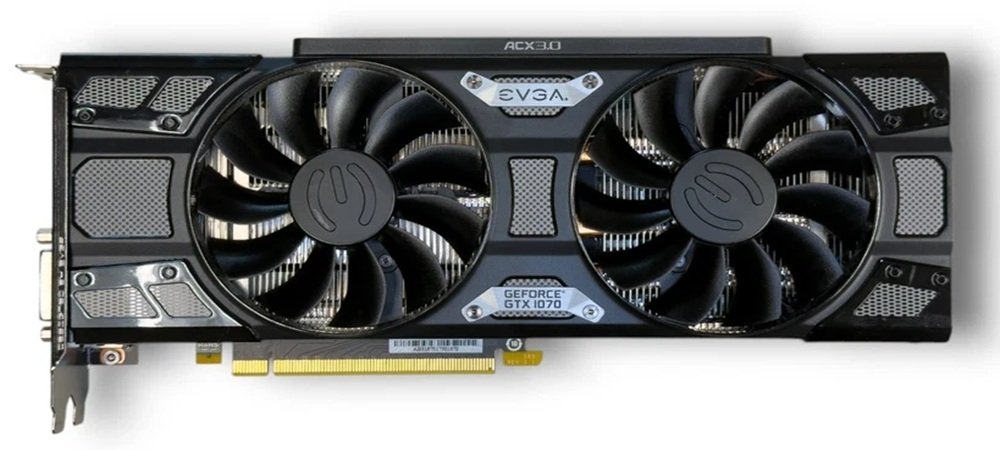
The GTX 1070 is the best used GPU under $100, full stop. It tracks at approximately $86, with a market average around $90. You are paying top of the budget for a card that launched at $379 in 2016, and you are getting roughly 85% of an RTX 3050‘s rasterization performance for less than a third of what a new 3050 costs today.
The 8GB VRAM buffer is the single biggest reason this card tops the list. 4GB cards hit a hard wall in modern AAA games, and 6GB cards are starting to feel the squeeze. 8GB gives you breathing room. Cyberpunk 2077 runs at 55 FPS on Low with FSR Quality, and the VRAM never maxes out. GTA V at Very High clears 120 FPS. Fortnite in Performance Mode pushes well past 200 FPS, and Valorant on competitive settings hits 320 FPS. CS2 at native 1080p averages around 220 FPS with a Ryzen 7 7800X3D.
The trade offs: Pascal has no tensor cores, so DLSS is unavailable. You are limited to FSR and XeSS in compatibility mode. No hardware ray tracing, which means games like Indiana Jones and the Great Circle will refuse to launch. Driver support is in legacy territory, though NVIDIA’s Pascal branch remains more actively maintained than AMD’s Polaris branch. Power draw is a modest 150W with a single 8-pin PCIe connector, so any decent 450W power supply handles it comfortably.
This is the card you buy when your budget can stretch to $90 and you want the most 1080p gaming performance possible without crossing the $100 line.
Radeon RX 580 8GB at ~$75

The RX 580 8GB is the value champion of the under-$100 market. For $75 you get 8GB of VRAM, which is the same buffer as the GTX 1070 for $15 less. That is the deal that makes this card the sweet spot for budget builders.
Real world performance: Fortnite on Low/DX12 averages around 110 FPS per testing from CheckFPS and YouTube benchmarks. Valorant on High hits 185 FPS. CS2 on Low reaches 150 FPS, though some testers report closer to 200 FPS with a strong CPU. GTA V on Very High lands between 75 and 90 FPS, which aligns with the results in our DDR3 gaming build that pairs the RX 580 8GB with a Core i7-4790K. Cyberpunk 2077 on Low with FSR Quality manages 55 FPS, matching the GTX 1070 thanks to the shared 8GB VRAM buffer.
The catch is twofold. First, AMD placed Polaris in a legacy driver branch, so you are getting security patches but no game day optimizations for new releases. Second, the RX 580 was the most mined GPU of the 2017 to 2018 crypto boom. A huge percentage of the cards on eBay right now spent two years running at 100% load in a mining rig. Before buying, demand a FurMark stress test video, check the VRAM thermal pads for discoloration, and run OCCT’s GPU Memory Test for errors.
Power draw is 185W with a single 8-pin connector, so you need at least a 500W power supply. This card will not work in a stock office PC without a PSU upgrade. If you are building around an old Dell OptiPlex or HP Compaq, skip down to the GTX 970 or RX 570.
GeForce GTX 1060 6GB at ~$57
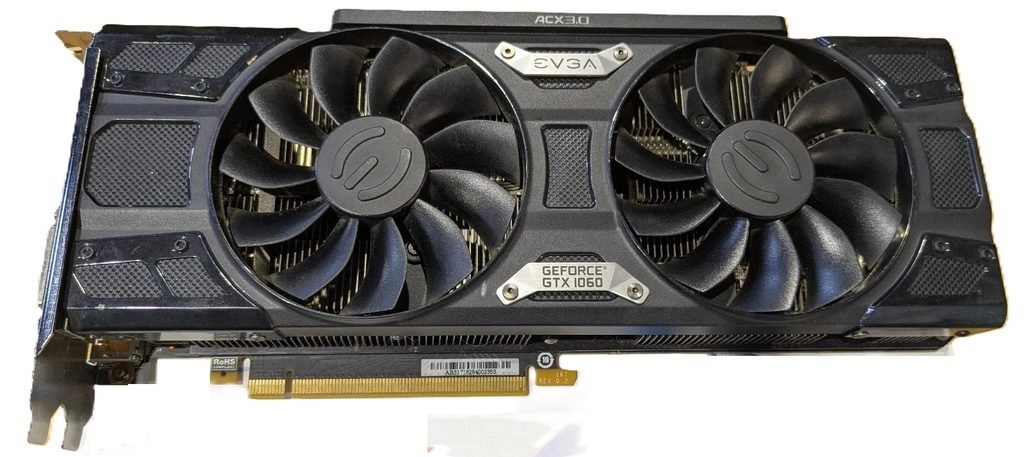
The GTX 1060 6GB splits the difference between the RX 580 and the GTX 1070 in both price and performance. GetPCParts tracks the current used value at $57. The recorded range across 36 price points spans $51 to $66, so anything under $55 is a good buy.
Benchmark data shows the 6GB variant pushing 180 FPS in Fortnite on Performance Mode, 280 FPS in Valorant on Low, and 240 FPS in CS2 on Low, all with a Ryzen 5 3600 CPU. GTA V on High hits 110 FPS. The weakness is AAA performance: Cyberpunk 2077 on Low struggles to reach 40 FPS even with FSR, and the 6GB VRAM buffer is starting to feel tight in 2024 and 2025 releases. Some newer games will require texture drops to Medium to avoid VRAM overflow stutter.
The advantage over the RX 580 is driver support. NVIDIA‘s Pascal branch is more actively maintained than AMD’s Polaris legacy branch, which means fewer compatibility issues with new game launches. The 120W TDP and single 6-pin power connector also make it easier to run on a modest 400W to 450W power supply. This is the card you buy when you want Nvidia‘s better driver longevity without paying GTX 1070 money.
GeForce GTX 970 4GB at ~$50
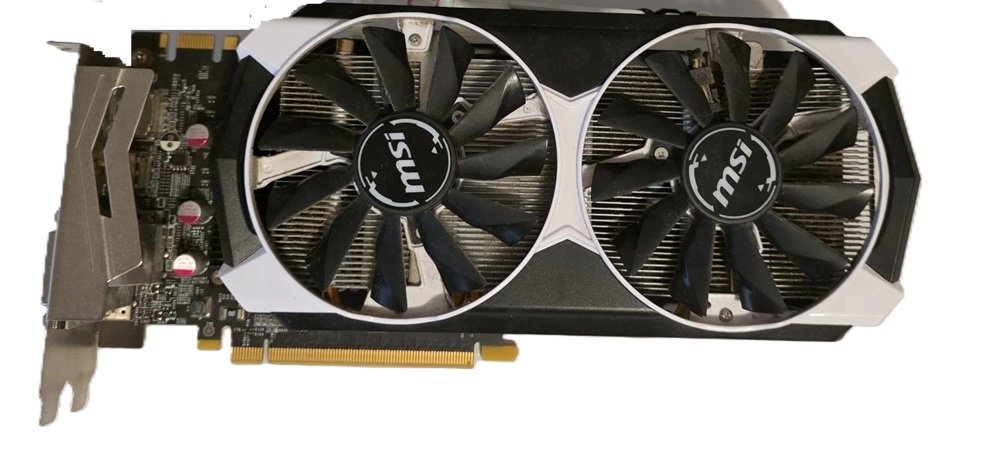
The GTX 970 is the cheapest Nvidia card still worth buying, but it comes with a famous asterisk. The card technically has 4GB of VRAM, but the last 512MB runs at a fraction of the speed of the first 3.5GB. When a game pushes past 3.5GB, performance drops off a cliff. The market average sits around $45, with a fair asking range of $45 to $50.
Performance estimates place Fortnite at around 140 FPS on Low (Performance Mode will be higher), Valorant at 185 FPS on competitive settings, and CS2 at roughly 130 FPS on High. GTA V manages 80 FPS on High. Cyberpunk 2077 on Low with FSR Ultra Performance mode reaches about 41 FPS. The 3.5GB VRAM limit means you must keep textures at Medium or Low in any modern game. Push textures to High and the slow memory pool kicks in, causing stuttering and frame drops.
Power draw is 148W with two 6-pin PCIe connectors, so you need a 450W to 500W power supply with the right cables. Maxwell is deeper in legacy territory than Pascal, so expect even less driver attention for new releases. This is the card you buy when the budget is tight enough, and you accept the 3.5GB VRAM ceiling in exchange for paying less.
Radeon RX 570 4GB at ~$40
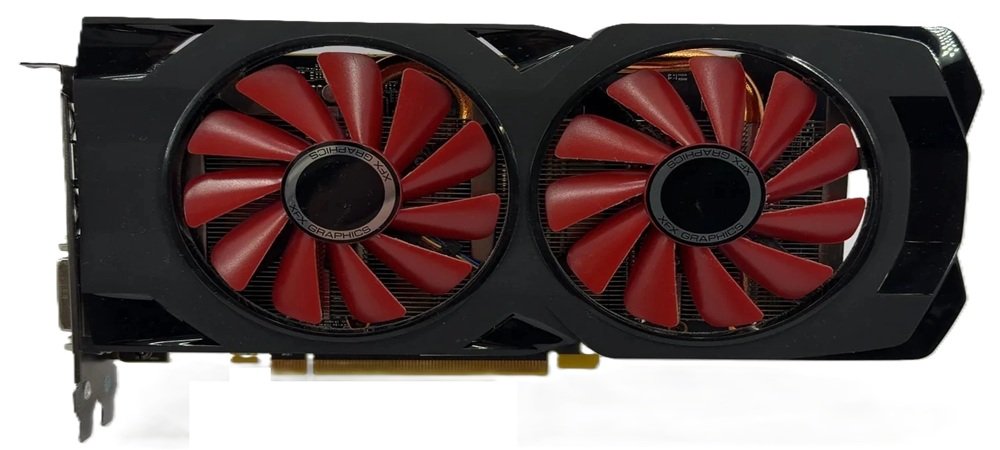
The RX 570 4GB is the floor of viable PC gaming. Recent sold listings show a median around $35 to $43. Realistically, you should pay between $35 and $45 for a tested, working card.
Performance shows Fortnite at 87 FPS on Low, which is the minimum acceptable for smooth battle royale gameplay. Valorant on Low reaches 200 FPS with a decent CPU, CS2 on Low manages around 110 FPS. GTA V hits 75 FPS on High settings. Cyberpunk 2077 on Low with FSR struggles to maintain 30 FPS, which is borderline. The 4GB VRAM buffer is the absolute minimum for modern gaming: some 2024 and 2025 titles will crash to desktop on a 4GB card because the engine cannot load basic geometry into such a small buffer.
This card shares the same Polaris legacy driver situation as the RX 580 and was also heavily mined. Power draw is 150W with a single 6-pin connector, so a 400W to 450W power supply is sufficient. The RX 570 is the card you buy when the budget is so tight that $20 extra for an RX 580 is a dealbreaker. It runs esports titles competently and older AAA games at 60 FPS. Anything released after 2023 is going to be a struggle. For more context on how this card fits into a complete budget build, check our super budget e-sports build that uses the closely related RX 470.
Mining Worn Polaris Cards (RX 570 and RX 580)
This is not a model to avoid, but a condition to avoid. The RX 570 and RX 580 GPUs were the workhorses of the 2017 to 2018 crypto mining boom, and a large percentage of the cards on the used market today spent years running at full load in mining rigs. The silicon itself is usually fine, but the VRM components, thermal paste, and fan bearings take a beating.
Signs of a mining card include yellowed or browned PCB near the power delivery section, fans that rattle or scrape when spun by hand, missing warranty stickers over the heatsink screws, and sellers listing multiple identical cards at once. If you buy one of these cards, budget $10 for new thermal paste and thermal pads, and be prepared to replace a fan within the first few months.
Where to Buy a GPU and What to Actually Pay
eBay is the safest platform for used GPU purchases thanks to buyer protection and the ability to filter by sold listings to see real market prices. Facebook Marketplace runs $5 to $15 cheaper for local cash deals, but you give up buyer protection and the ability to verify sold-price history. For any purchase, use a payment method with dispute resolution: PayPal Goods and Services on eBay, or Facebook’s built-in checkout. Never wire transfer money or use untraceable payment apps for a used GPU.
Here is what you should actually pay for each of the five recommended cards, based on GetPCParts verified sold data and ResalePrices aggregates as of October 2026:
| Card | Good Buy Price | Fair Market Price | Walk Away Above |
|---|---|---|---|
| GTX 1070 8GB | $80 | $86 to $90 | $100 |
| RX 580 8GB | $58 | $70 to $75 | $85 |
| GTX 1060 6GB | $49 | $55 to $60 | $70 |
| GTX 970 4GB | $36 | $43 to $50 | $60 |
| RX 570 4GB | $35 | $40 to $45 | $55 |
The “good buy” column is the price where you should pull the trigger immediately. “Fair market” is the normal range for a tested card from a seller who accepts returns. Anything above the “walk away” threshold means you are overpaying, and a better deal will show up within a week if you set up saved searches on eBay.
Final Thoughts
Set up eBay saved searches with email alerts for each card you are considering. Filter by “sold listings” to watch the actual market price trend over a week before bidding. Listings that sit unsold for days are priced too high. Bids that close in the final seconds with multiple bidders indicate genuine market demand. Patience saves $10 to $20 on every purchase.